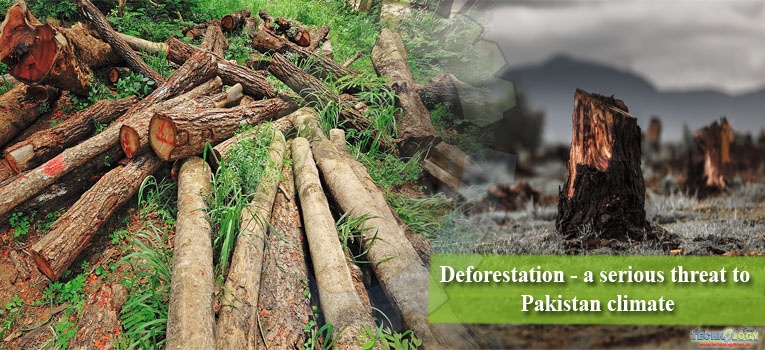
Pakistan is facing numerous environmental threats that are affecting its sustainable economic future. Among-st, land degradation emerges to be the worst warning. The study found that altogether 140 million hectares, which is equal to 43 per cent of the region’s total agricultural land, suffered from one or the other form of land degradation. Of this, 31 million hectares were strongly and 63 million hectares moderately degraded.
In Pakistan, land degradation mainly encompasses deforestation and desertification, salinity and sodicity, soil erosion, water logging, depletion of soil fertility and negative nutrient balances.
- Deforestation and Desertification:
Pakistan has a total forest area of about 12 million hectares. Out of that, the total forest, scrub, and planted trees spread on 4.2 million hectares, natural and modified coniferous scrub, rive rain and mangrove forests spaced 3.5 million hectares, tall tree forests encompass 2.4 million hectares, scrub forest exist on 1.1 million hectares, and plantations occupy 0.7 million hectares.
The forest area of Punjab is only less than 3% per cent whereas in Sindh it becomes even half of that. The continuous destruction of forests is causing a substantial loss. The declining rate of woody biomass is the second highest in the world. It ranges between 4-6% per year. Almost 7,000 to 9,000 hectares are deforested every year and this rate is especially severe in the north where the per capita consumption for fuel wood is 10 times higher due to the ruthless winters.
Strategies to control Desertification and Deforestation:
- Introduction of fast-growing tree species and grasses for stabilization of shifting sand dunes and creation of micro climates through shelterbelt plantation.
- For sustainable land management (SLM), soil and water conservation, afforestation and rehabilitation of degraded land, repetitive high resolution satellite images, delineation and mapping of affected areas, are suitable tools for combating desertification.
Planting more trees – the roots of trees hold the soil together and help to reduce soil erosion from wind and rain.
- Salinity and Sodicity:
In majority of the soils of plains in Pakistan, the rainfall is usually low and the evapotranspiration is higher than the annual precipitation resulting in buildup of salts in the soil profile and their accumulation on the soil surface. At country level, 6.28 million ha of area is affected with salinity and sodicity. The majority of salt affected soils are saline-sodic in nature. These salt affected soils are causing potential reduction in yield.
Technologies to control salinity:
- Good quality water
- A practice of intermittent deep-plowing and heavy irrigation is adopted, by which salts are leached.
- Rice-berseem rotation helps to leach salts and improve soil productivity.
- Soil is reclaimed by growing salt grass, ‘Dhancha’ and other green-manures, and applying FYM, straw and crop-residues.
- Deep-plowing, sub-soiling, sanding and profile-inversion for gypsiferous saline-sodic soil.
- Various types of drainage-systems (vertical drainage by installing tube-wells; horizontal drainage; tile drainage; surface drainage) are used for soil reclamation.
- In Pakistan, the generally recommended salt-tolerant plant-species include: “Kallar” grass, Artiplex spp, Acacia spp. and Eucalyptus spp.
- Soil Erosion:
Soil erosion implies loss or removal of surface soil material through the action of moving water, wind or ice. About 13.05 million hectares of area is affected by water erosion and about 6.17 million hectares is affected by wind erosion.
The highest recorded rate of erosion is estimated to be 150-165 tones/hectare/year. The Indus River carried the fifth largest load of sediment in the world in 1990. According to some estimates the Indus is adding 500,000 tones of sediment to the Tarbela Reservoir every day, reducing the life of the dam by 22% and the capacity of reservoir by 16%.This reduces the productivity of the land by 1.5-7.5% per year. This affects almost one-fifth of the Punjab.
Technologies for Controlling Soil, Water and Wind Erosion:
• Provision of surface-cover that intercepts the rain before hitting the soil.
• Reducing the amount of runoff by promoting infiltration.
• Maintenance of borders (“Watbandi” land- leveling and terracing) in the field.
• Cover cropping.
• Stubble mulching
• Minimum tillage
• Minimize grazing and cutting
• Maintaining a healthy, perennial plant cover.
• Crop Rotation
- Depletion of Soil Fertility and Negative Nutrient Balances:
The fertility status of Pakistani soils is rapidly depleting. The data generated by the public and private organizations in the country reflect the general agreement about the deficiency of nitrogen in 100% soils. Same is the situation with organic matter content, which is on around average 0.5% only. In case of phosphorus, more than 90% soils are deficient.
The main causes of soil nutrient depletion are:
- Leaching of nutrients by irrigation water and by rain in high rainfall areas.
- Continuous cultivation of soils over long periods, with almost unchanged cropping patterns dominated by exhaustive crops like wheat, sorghum, maize, cotton, sugar cane and mustard.
- A hot and arid climate in many parts of the country, leading to high decomposition rates of organic matter and a net loss in the organic content of soils.
- Inadequate addition of organic fertilizers or green manure, resulting in a constant decrease in the organic content of soils.
- Continued use of single-nutrient fertilizers (like urea) which has lead to increased extraction and hence deficiency of other plant nutrients from the soil.
- The Water-Logging Problem:
Pakistan’s agriculture depends on the gigantic network of canal-system, as irrigation-system of the Indus Basin covers about 16.6 mha. High water-table has serious adverse affect on agriculture, due to restricted aeration in the root zone, soil salinization, reduced bearing capacity of soil, weakened foothold of the crops and increased attack of crop-diseases.
Technologies to Control Water Logging:
• Installation of tube-wells for irrigation and vertical drainage
• Construction of surface-drains and tile-drains
• Planning and designing of future canals on proper lines.
• Lowering of water-levels of canals.
• Conversion of perennial to non-perennial irrigation
• Lining of water-channels.
• Optimizing water-use, e.g. by avoiding cultivation of high-delta crops on moderately to rapidly permeable soils.
• Planting of eucalyptus in water-logged areas.